Think about a plumber who runs his own business. He does not wake up each morning and decide whether he feels like charging for a call-out. He has a price list, a set of tools, a way of quoting and a routine for invoicing. The business runs on rules, and those rules protect him on the days he is tired, sick or distracted.
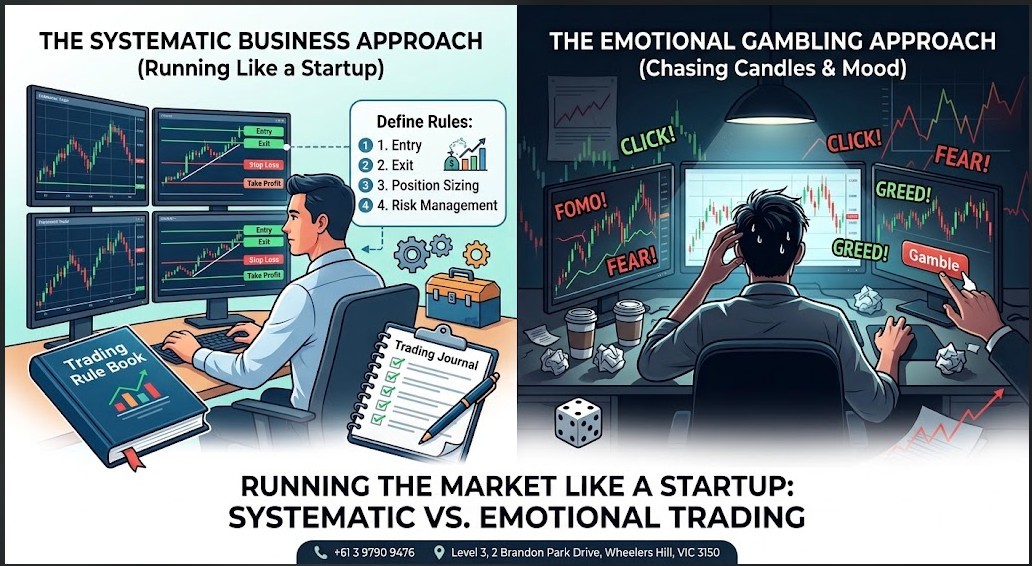
Now think about how most people trade. They open a chart, watch a candle move, feel a small rush, and click. Nothing was written down before the money moved. There is no price list, no quoting process, no invoice. This is the difference between running a business and gambling with a business card.
Systematic trading is what happens when a trader decides to run the market like a startup. Not because startups are glamorous, but because a startup survives on process, feedback and iteration rather than on how the founder feels at nine in the morning.
What Systematic Trading Actually Means
Systematic trading, also known as mechanical trading, is a way of defining trade goals, risk controls and rules so that trading and investment decisions get made in a methodical way. It covers four things: when you enter, when you exit, how much you commit, and how much you are prepared to lose. Every one of those decisions sits inside a predefined set of rules.
The key word is predefined. A rule written after the trade is not a rule, it is an explanation. Objective criteria that can be recorded and reviewed are what separate a system from a mood.
Why the Startup Mindset Fits Trading So Well
A startup founder tests small ideas, measures what happens, and keeps what works. She does not bet the company on one product simply because she feels strongly about it.
Traders can borrow the same loop. Define a rule, test it on historical data or on a demo account, record the outcome, then adjust one variable at a time.
The founder metaphor also explains why most systems fail. Startups rarely die because the original idea was weak. They die because the founder changed direction every fortnight.
Traders do exactly the same thing with strategies, abandoning a rule set three losing trades in and starting again from zero.
The Four Decisions You Must Lock Down
Any rules-based approach has to answer four questions before money is involved. If any one of them is left open, emotion will fill the gap for you.
| Decision | Question it answers | What goes wrong without it |
| Entry | Under exactly what conditions do I buy or sell? | You chase candles and enter late |
| Exit | Where do I take profit and where do I accept the trade is wrong? | Winners get cut early and losers get held |
| Position sizing | How much do I commit to this single trade? | One trade can undo months of progress |
| Risk management | What is my maximum loss for the day, week and month? | You keep trading to get even |
What Emotional Investing Quietly Costs You
Emotional trading is not a character flaw. It is a design flaw. Fear and greed are useful when you need to escape a burning building. In a leveraged market they push traders into the same three habits: closing winners too early, holding losers too long, and adding size to win back what was just lost.
None of that shows up on a chart as a signal. It shows up on a statement as a pattern. That is why we ask students to journal the reason for every entry, not just the price. The journal exposes the emotional rule that has been running quietly underneath the written one.
Instinct Does Not Disappear, It Changes Route
Experienced traders often resist rules because they believe rules kill feel. True systematic trading does not take away instinct and feel. It changes how instinct is transmitted into the trade. Your read on the market still matters, but it enters at the design stage, when you build and refine the rule set, rather than in the middle of a losing position late at night when you are bargaining with the screen.
Manual Systems and Automated Systems Both Count
Systematic trading includes both manual trading of a system and full or partial automation using computers. Plenty of successful systematic traders click the button themselves.
Technical systematic systems are more common, although rules can also be built on fundamental data. Automation is a convenience, not a definition, and you should not let the absence of a coding background stop you from starting.
Where This Approach Is Already Standard
Systematic traders are, in effect, hedge funds that trade macroeconomic markets such as foreign exchange, commodities, fixed income and equity indices through quantitative processes. The same logic scales down to an individual account on the ASX or in the forex market. The instruments change. The discipline does not.
Building Your First Rule Set
You do not need software, a data science degree or a programming language. Start with one market and one setup, then write the instructions down as if you were leaving them for someone else.
- Choose a single market and a single timeframe, then stay there long enough to gather a meaningful record.
- Describe your setup in plain English so a friend could recognise it on a chart without your help.
- Write the exact entry trigger, including the time of day you are allowed to act.
- Write the exit before you enter, both the target and the point where you admit the trade is wrong.
- Write the position sizing rule and tie it to the amount you are willing to lose on one trade.
- Record every trade with the reason, the rule it matched and the outcome.
- Review the record monthly and change only one thing at a time so you can see what caused the difference.
Mistakes That Quietly Break a Good System
- Moving the stop loss after entry, which turns a defined risk into an open-ended one.
- Rewriting the rules immediately after a single loss instead of reviewing a proper sample of trades.
- Trading five markets at once before any single rule set has proven itself.
- Keeping no written journal, then relying on memory, which is generous to the ego.
- Copying another trader’s system without understanding the logic behind each rule.
- Skipping the review, which is where most of the actual learning lives.
Start Small, Then Scale
Size is the last thing to increase, never the first. A rule set that cannot survive small size will not suddenly work when the numbers grow. Trade the smallest position your broker allows, or work on a demo account, until the process feels boring. Boring is the target. Boring means the decision has already been made and you are simply executing it.
Once the record shows that your entries, exits and sizing are consistent, and that losses stay within the limits you set, you have something worth scaling. That is a business decision supported by data, which is exactly how a startup grows.
What We See in Australian Coaching Rooms
Over the years our mentors have sat with students from many backgrounds, including plumbers, electricians, engineers, accountants and IT professionals. The pattern is remarkably consistent. The people who improve fastest are not the ones with the largest accounts. They are the ones who write things down.
Early sessions usually involve a student explaining that the market moved because of a particular headline. By the fourth or fifth session, the same person is asking a different question: did the trade meet my rules? That shift in the question is the moment a retail trader starts behaving like a systematic trader.
How N P Financials Teaches Systematic Trading
N P Financials was founded in 2013 and has trained over 33,000 individuals globally. We teach forex, shares, commodities, bonds, indices, intraday and cryptocurrency trading through one-on-one courses and mentoring, with trader psychology programs sitting alongside the technical material. You can see the full range of programs at the N P Financials homepage.
Our trading blog carries regular articles on risk, psychology and market structure that support the rule-writing process, and the main site explains course structure and how to book a session. If you would rather speak with a person first, call +61 3 9790 9476 or email info@npfinancials.com.au. We are located at Level 3, 2 Brandon Park Drive, Wheelers Hill, Victoria 3150.
The courses suit people who want to run their trading the way they run a business or a career, with a process, a review cycle and a written plan. That is the whole idea behind systematic trading, and it is the reason so many of our students keep a rule book beside their trading journal.
Frequently Asked Questions
Is systematic trading profitable?
Having rules does not guarantee a profit. What rules do is make performance measurable. When you record every entry, exit and position size, you can see whether your approach has an edge across a meaningful sample of trades, and whether your losses come from the market or from breaking your own process. Trust your own journal ahead of anyone else’s claims.
What is the difference between systematic and algorithmic trading?
Systematic trading describes the method, which is a predefined rule set covering entry, exit, position sizing and risk management. Algorithmic trading describes the delivery, which is using computer code to execute those rules. A trader can be fully systematic with pen and paper and no automation. Systematic trading includes both manual trading of a system and full or partial automation using computers.
Do I need to code to trade systematically?
No. Code helps with speed, with testing rules across large data sets, and with removing manual error. It is not the definition of the method. Many traders run manual systems across a small number of markets and still follow objective rules. If coding interests you, learn it after your rules are clear and written down.
How is systematic trading different from quantitative trading?
The terms overlap in everyday use. Quantitative trading leans heavily on mathematical models and statistical analysis, while systematic trading focuses on the framework of rules that governs every decision. In practice, a trader may use quantitative analysis to design the rules, then run the strategy systematically with clear entry, exit and risk parameters that can be recorded and reviewed.
Can a complete beginner start systematically?
Yes, and beginners often adapt faster because they have fewer habits to unlearn. Start with one market and one written setup. Keep position size small while you build a record of trades. The N P Financials team can walk you through the process in a one-on-one session, which suits anyone who prefers learning with a mentor rather than alone.
