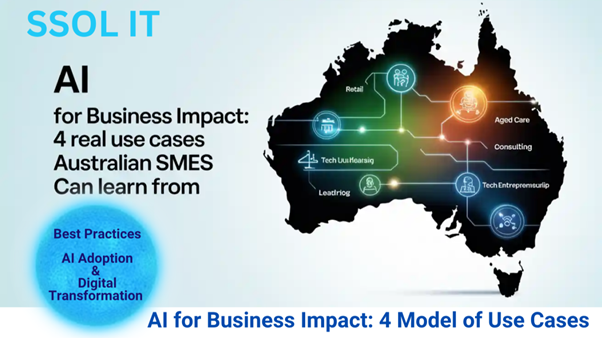
2026 will see digital disruption and artificial intelligence playing an increasingly significant role in Australian businesses’ growth, competitiveness, and risk management strategies. Major CEOs across banking, retail, mining, healthcare and professional services sectors are investing more money in AI-powered systems that boost productivity while improving customer experiences and making companies more resilient over time.
Not only has spending increased in 2026, but so has how people approach spending. CEOs are moving away from pilot projects that simply serve to test ideas and toward deployments that bring tangible benefits that yield real measurable value.
Why AI Investment Has Become a CEO Priority?
Digital disruption was once solely the responsibility of IT or innovation teams; now however, AI investments are on every CEO’s agenda for 2026 as leaders understand its significance for every aspect of business, from processes and decision making to building trust with customers and developing worker skills.
Costs are increasing, efficiency can be an issue and global competition is fierce. AI allows you to get more done with what tools you already have by automating tedious tasks and providing insights you couldn’t otherwise access before.
AI should also be seen by CEOs as an investment that will protect them; falling behind on digital skills could quickly threaten your competitive edge; thus making change an imperative, rather than optional decision.
Banking and Financial Services: Smarter, Faster Decisions
AI investments in financial services tend to focus on improving customer experience, speed, and risk management. Machine learning has already proven its usefulness at major banks by improving how they check credit, detect fraudsters, and make digital exchanges more personal.
Leaders at banks like Westpac are placing great importance on AI tools that increase speed and accuracy while remaining compliant with regulations. Automation has greatly reduced manual work that needs to be completed manually for loan reviews or new customer onboarding processes – freeing up staff for more vital tasks.
CEOs are investing heavily in cybersecurity and data control systems because they recognize that trust is paramount when using AI on an expansive scale in highly sensitive fields.
Retail CEOs: Using AI to Understand Customers Better
Retail leaders are employing artificial intelligence with an eye toward understanding customers. In 2026, big stores are investing heavily in data analytics as an aid in anticipating demand, finding competitive prices and performing targeted marketing.
AI technology is being employed by companies like Woolworths Group to reduce waste, improve supply chain efficiency and provide personalized promotions that cater to each customer. Such programs help companies maintain safe profit margins while still offering significant savings to shoppers looking for bargains.
CEOs in retail businesses must tread lightly when automating too heavily. Many believe AI should only supplement field workers rather than replace them as it’s people who create customer loyalty and enhance service quality.
Mining and Energy: Automation for Safety and Productivity
Investments in AI have revolutionized how mining and energy processes are carried out, creating safer and more cost-efficient operations through automation, predictive maintenance and real-time monitoring. CEOs now prioritize automation solutions as part of their safety initiatives.
Rio Tinto and other global companies are adopting digital solutions such as self-driving cars, artificial intelligence to monitor equipment, and advanced data analytics for production improvements.
AI for CEOs working in this industry is less about being experimental and more about being reliable; AI must work reliably, even in harsh and remote locations, providing enormous benefits such as reduced costs, safer processes and more effective use of assets.
Healthcare and Professional Services: Augmenting Expertise
CEOs in healthcare and professional services are investing heavily in artificial intelligence (AI), not to replace people, but to assist their efforts more efficiently and accurately. Workers can work faster and more accurately using decision support tools, document automation platforms and data analysis software.
Healthcare leaders are turning to AI technology for improved diagnosis, patient scheduling and resource allocation. AI is also being utilized by professional services firms to examine large datasets easier while streamlining compliance measures and offering enhanced advisory services.
CEOs believe data protection and ethical use to be of great importance, which is why strong governance systems often accompany investments to ensure they are used responsibly. When big bets pay off with real gains, that’s when real wins become possible.
The Shift From Big Bets to Practical Wins
2026 has seen an increasingly frequent trend toward simpler investments with faster returns that can be tracked more closely by CEOs.
Leaders don’t aim to change everything at once; rather, they focus on specific problems like manual processes, slow decision-making or not having enough customer information. Once tests show promise, they are used across an organization.
This methodical approach to digital transformation draws from our experiences with past transformation projects that were grand in scale but failed to produce tangible results.
AI and the Workforce: Reskilling, Not Replacing
AI in the workplace is reskilling rather than replacing employees. CEOs consider carefully how their decisions impact employees; AI may perform certain routine jobs automatically; however, most leaders prioritize retraining rather than replacing people.
Training, data analytics knowledge acquisition and managing change management have become integral parts of digital transformation funds. CEOs recognize that adopting new technologies won’t work without their employees’ support and skillset.
Leaders in 2026 who view AI as a means of giving employees greater freedom by decreasing administrative tasks and freeing up more time for creativity and problem-solving will likely experience the greatest success with it.
Data as the Foundation of Transformation
CEOs frequently emphasize that clean and accurate data is crucial to making AI work well. Without clean, accurate information available to use for running algorithms effectively, even powerful ones won’t do their job properly.
As a result, companies are investing a great deal of money into data infrastructure, control, and integration. Many are upgrading old systems so data can be seen and analyzed more quickly; although this work might go unseen by most observers, CEOs see it as essential to long-term digital change. Executives also see it as necessary in taking care to safeguard risks and rules in these investments.
Managing Risk and Regulation
As AI usage increases, so too do its associated risks. CEOs of companies using AI must remain cognizant of potential threats to their image, ethics and compliance with laws and rules.
Large companies in 2026 are developing AI governance systems with audits, oversight committees, and ethical standards as a part of their AI strategies. CEOs want to make sure AI decisions can be explained, are fair, and adhere to new rules.
AI is no longer seen as a novelty; rather it serves an integral infrastructure role – as evidenced by this risk-aware approach to AI use.
Investment Levels and ROI Expectations
With more money being invested, CEOs are under immense pressure to show tangible returns for their digital spending. Boards and investors want clear links between digital spend and the success of the business.
Cost reduction, revenue growth, customer happiness and risk reduction are increasingly being used as metrics for AI projects. CEOs also recognize their long-term value, such as adapting and evolving.
Digital transformation in 2026 won’t depend solely on its goal; what matters more is how well it’s executed.
Collaboration and Partnerships
An emerging trend among CEOs today is working collaboratively and making deals. Instead of building everything themselves, CEOs now enlist help from tech companies, startups and study groups in creating solutions.
Relationships that enable faster deployment and offer access to specialized knowledge make for faster business operations and increased operational speed. CEOs remain concerned with dependence and data security concerns; for that reason they prefer flexible deals that maintain control.
Strategic partnerships have become an increasingly important way of gaining a competitive edge and speeding creativity.
What does this mean for Australia’s Competitiveness?
Australia’s economic future is being determined by investments CEOs are making in artificial intelligence and digital transformation, and companies that use technology effectively can compete globally, attract top talent, and expand in ways that last over time.
Nationally, these investments help increase output while also addressing structural problems such as a skill shortages and rising costs. More Australian CEOs see digital skills as integral to being competitive rather than simply an improvement to operations.
Challenges That Remain
Problems still remain, despite growth. Change can be hindered by old methods, cultural resistance and an inadequate skill base; cybersecurity risks continue to escalate so their monitoring must remain an ongoing task.
CEOs recognize that digital transformation isn’t an instantaneous endeavor, but an ongoing journey that demands ongoing support and flexible leadership from leaders. Strategy, technology and people all must come together for optimal results.
Conclusion
CEOs are investing money into AI and digital change with an eye toward how it will work in the real world, placing high priority on technologies that help manage risk while supporting employees while being efficient, insightful, and resilient.
Now is no longer the time for experimentation; now is the time for action. CEOs who use AI strategically are creating long-term economic advantages through digital investments that provide long-term economic competitiveness for their companies.
As change speeds up, one lesson stands out: success cannot solely be driven by technology.